
Swiss Machining: How Swiss-Type Turning Works and When to Specify It
A sliding headstock, a guide bushing, and support at the point of cut — the simple mechanical idea behind Swiss screw machining, and why it holds ±0.0002" on parts a conventional lathe cannot touch.

IsoCNC Engineering Team
CNC Machining & DFM Engineers · Updated · 15 min read

On this page
Quick Answer
Swiss machining (also called Swiss turning or Swiss screw machining) is CNC turning in which the bar stock slides through a guide bushing that supports it immediately at the cutting point. The sliding headstock feeds the bar in Z while fixed tools cut next to the bushing, so the workpiece behaves like a short stiff stub instead of a long flexible rod. That single difference lets a Swiss-type lathe hold ±0.005 mm (±0.0002") on parts up to 20:1 length-to-diameter ratio — pins, shafts, bone screws, connector contacts — in bar diameters up to roughly 32–38 mm. Specify it for slender, tight-tolerance parts in production volumes; leave big, short, or one-off parts to conventional turning.
How a Swiss-Type Lathe Works: Sliding Headstock and Guide Bushing
On a conventional lathe the headstock is fixed: the workpiece spins in a chuck and the tools travel. A Swiss-type lathe inverts the logic. The headstock itself slides along the Z axis, pushing and pulling the bar through a guide bushing while the cutting tools sit stationary just in front of the bushing face. The collet in the headstock grips the bar and provides both rotation and feed. A servo-driven bar feeder keeps 12-foot bars coming, so the machine runs unattended for long stretches.
The guide bushing is the part that matters. It supports the rotating bar within a very short distance of the tool, so the section being machined acts like a short, stiff stub rather than a long, whippy rod. Deflection, vibration, and chatter — the three things that ruin long slender parts on a conventional lathe — are suppressed at the source. Rotary bushings spin with the workpiece and are the standard choice; fixed bushings exist but can mark the material. Because the bar slides through the bushing with only a small clearance, the process is picky about stock: shops buy centerless-ground bar with tight diameter tolerance and good straightness, because a bent or out-of-round bar chatters in the bushing and scraps parts.
The idea is older than CNC. A watchmaker named Jakob Schweizer developed the sliding-headstock lathe around 1872 in Switzerland’s Biel/Bienne watchmaking region to make tiny accurate screws, and the name "Swiss screw machine" stuck. The machines stayed cam-driven for nearly a century until Tornos shipped the first numerically controlled sliding-headstock lathe in 1978. Today’s CNC Swiss lathes come from Citizen, Tsugami, Star, and Tornos, and the "screw machine" label survives mostly as history — these machines turn out implants and connector pins far more often than screws.
Swiss Machining vs Conventional CNC Turning
The two processes overlap, but they are optimized for opposite ends of the part spectrum. A conventional lathe wins on large diameters, heavy cuts, and fast changeovers. A Swiss lathe wins on long, slender, tight-tolerance parts in repeat volumes. Modern Swiss machines control 7–13 axes against 2–5 on a typical CNC lathe, and because the bushing absorbs cutting forces, they can take deeper cuts in a single pass on small stock. For a broader look at where turning sits relative to milling, see our milling vs turning comparison.
| Criterion | Swiss-Type Lathe | Conventional CNC Lathe |
|---|---|---|
| Headstock | Sliding — feeds the bar in Z through the guide bushing | Fixed — tools travel along a chucked workpiece |
| Workpiece support | Guide bushing at the point of cut | Chuck or collet at one end, optional tailstock or steady rest |
| Bar capacity | Roughly 2–38 mm; most machines top out at 20–32 mm (1.25") | Up to ~180 mm on large-bore machines |
| Length-to-diameter ratio | Excellent past 3:1; 20:1 slender pins and shafts are routine | Poor beyond ~3:1 without added support |
| Axes | 7–13 typical with sub-spindle and live tooling | 2–5 typical |
| Production tolerance | ±0.005 mm (±0.0002") routine on small diameters | Wider on comparable slender geometry |
| Setup and changeover | Hours — bushing, collets, multi-post tool layout, spindle sync | Faster — suits frequent job changes |
| Ideal volume | Repeat runs from hundreds to 10,000+ | Job-shop mix, large parts, prototypes |
A rule of thumb that holds up on the shop floor: if the part is under about 32 mm in diameter, longer than three times its diameter, and toleranced tighter than ±0.025 mm, it belongs on a Swiss lathe. Above a 10:1 length-to-diameter ratio, conventional turning is not really an option at all without steady rests and multiple operations.
Done-in-One: Main Spindle, Sub-Spindle, and Live Tooling
A modern CNC Swiss lathe is much more than a lathe. Gang tool posts above the guide bushing carry turning tools in sequence; live (powered) tooling stations handle cross drilling, cross milling, polygon turning, and thread whirling; and a sub-spindle picks the part off the main spindle in a synchronized handoff, then machines its back side while the main spindle is already starting the next part. Front and back working overlap, cross holes and flats happen in the same cycle, and the part drops off the machine complete.
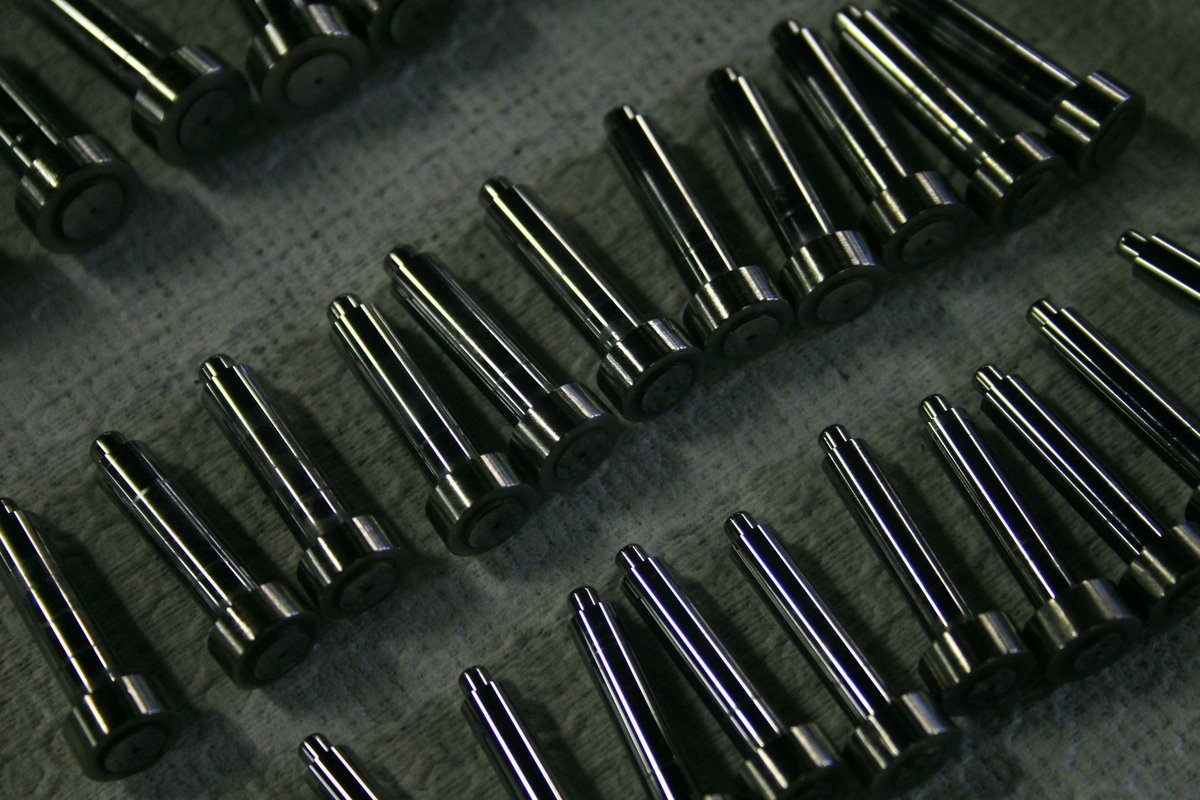
This is the economic heart of Swiss screw machining. Every secondary operation a part avoids is a setup, a queue, a handling step, and a fixturing error it never incurs. A connector pin with a cross hole and a back-side thread might take three setups across a lathe and a mill the conventional way — on a Swiss machine it is one program, one bar, one cycle. That is also why Swiss cycle strategy differs from conventional turning: instead of roughing and finishing the whole profile in separate passes, the machine turns each section to finished size as the bar advances through the bushing.
Parts and Materials That Belong on a Swiss Lathe
The classic Swiss part is small, cylindrical, long for its diameter, and needed in quantity: pins, shafts, arbors, connector contacts, valve spools, fuel-injector components, fasteners, and fittings. Medical is the showcase industry — bone screws, surgical anchors, and dental implants are textbook Swiss parts, which is why the process anchors so much of medical device machining. Electronics runs close behind with contact pins and coaxial connector bodies at high length-to-diameter ratios, and automotive consumes fuel-system and sensor components in the millions.
Swiss machines cut nearly any bar-fed material, but the bar must run through the guide bushing, so machinability, chip control, and bar quality matter more than on a conventional lathe.
| Material Group | Common Grades | Notes for Swiss Turning |
|---|---|---|
| Free-cutting & carbon steel | 12L14, 1215, 4140 | Free-cutting steels are the chip-control benchmark; fastest cycles in the ferrous group |
| Stainless steel | 303, 304, 416, 316LVM, 17-4 PH | 303 machines freely; 316LVM and 17-4 serve implants and instruments; 416 is the free-machining martensitic option |
| Titanium | Grade 5 (Ti-6Al-4V), Grade 23 ELI | Implant-grade work; lower speeds, sharp tools, disciplined tool-life tracking |
| Brass & copper | C360 brass, C110 copper | Fast cycles and excellent surface finish; C360 is the machinability benchmark |
| Aluminum | 6061, 7075 | High spindle speeds; gummy chips need good coolant and chip-breaker geometry |
| Cobalt/nickel alloys | MP35N, L605, Elgiloy, Nitinol | Implant-grade; slow, rigid, and tool-wear-sensitive |
| Engineering plastics | PEEK, acetal (POM), nylon | Stable plastics run well; watch heat at the bushing interface |
On the steel side, free-cutting grades like 12L14 set the chip-control benchmark — the same logic covered in our guide to free-machining steel. In brass, C360 is the machinability reference for the whole industry; see machining brass for grade detail. Whatever the alloy, specify centerless-ground stock for guide-bushing work: bar straightness and diameter tolerance directly determine chatter, concentricity, and tool life.
The Cost Equation: Setup, Cycle Time, and Volume
Swiss machining costs more to start and less to run. New machines run upward of $150,000, and a setup is genuinely involved — guide bushing selection and clearance adjustment, matched collets, tool layout across multiple posts, and main/sub-spindle synchronization add up to hours before the first good part. Programming is likewise heavier: overlapping front and back operations is where cycle time is won, but sequencing and dwell decisions take an experienced programmer to get right.
Once running, the economics flip. Continuous bar feeding, simultaneous front/back working, and done-in-one completion drive per-part cost down hard, especially against any conventional route that would need second operations. The decision framework is a simple break-even: divide the setup-cost difference by the per-part cycle-cost difference between Swiss and conventional turning. Below that volume, conventional wins; above it, Swiss wins — and the crossover arrives earlier the more slender or complex the part is. Practically, that means prototypes and ones-and-twos usually go on a conventional lathe, while repeat runs from a few hundred pieces to tens of thousands belong on Swiss. Our CNC turning and Swiss CNC machining teams make this call on drawings every day.
When to Specify Swiss Machining on a Drawing
You rarely need to name the process on the print — a good shop will route the part — but knowing the trigger conditions makes you a better buyer. Send a part to Swiss when it checks most of these boxes: diameter under ~32 mm; length-to-diameter ratio above 3:1; tolerances tighter than ±0.025 mm on slender features; cross holes, flats, threads, or back-side features that would otherwise need a second setup; and volume from a few hundred pieces upward. Material in a standard bar grade, ordered as centerless-ground stock.
Keep it off Swiss when: the diameter exceeds ~38 mm (conventional lathes reach roughly 180 mm); the part is short and stubby with no deflection problem to solve; or the quantity is one to a handful of prototypes, where the setup hours will swamp the piece price. On the drawing itself, the things that help a Swiss shop most are honest tolerances (do not blanket ±0.0002" — put it where function needs it), a material callout with temper, and a note on which features are critical so the programmer can keep them in the front-working section of the cycle. For overseas sourcing, our China CNC machining page covers how we run Swiss production with full inspection documentation at a structurally lower cost basis.
FAQ: Swiss Machining
What is Swiss machining, in plain terms?
Swiss machining is CNC turning where the bar stock slides through a guide bushing that supports it immediately next to the cutting tool. Instead of the tool traveling along a chucked workpiece, the headstock itself moves, feeding the bar through the bushing while fixed gang tools cut right at the point of support. Because the material is braced where it is cut, the machine holds tight tolerances — ±0.005 mm (about ±0.0002") is routine — on small, long, slender parts that would bend and chatter on a conventional lathe. The process is also called Swiss turning, Swiss CNC machining, or Swiss screw machining; the names are interchangeable on modern equipment.
Why is it called a Swiss screw machine?
The design was invented in 1872 by Jakob Schweizer, a watchmaker in the Biel/Bienne region of Switzerland, to make the tiny, precise screws the watch industry needed — conventional lathes of the era could not hold the accuracy. The sliding headstock supporting the work at the cut solved it, and builders around Moutier industrialized the automatic lathe shortly after. The 'screw machine' name stuck because screws were the original product, even though today's CNC Swiss lathes turn out medical implants, aerospace fittings, and connector pins far more often than screws. The technology stayed cam-driven for nearly a century; Tornos introduced the first numerically controlled sliding-headstock lathe in 1978.
What is the difference between a Swiss lathe and a regular lathe?
A regular lathe holds the workpiece in a chuck with a fixed headstock and moves the cutting tools along it. A Swiss-type lathe inverts that: the headstock slides, pushing the bar through a guide bushing while tools cut immediately in front of the bushing face. Three consequences follow. First, deflection is controlled at the cut, so long thin parts hold size and concentricity. Second, a sub-spindle can pick the part off and finish its back side while the main spindle starts the next part, so complex parts come off complete. Third, the machine runs from bar stock through a 12-foot bar feeder, enabling long unattended runs. The trade is a smaller diameter ceiling (roughly 38 mm), longer setups, and higher machine cost.
What tolerances can Swiss machining hold?
On small diameters with a good machine, stable thermals, and fresh tooling, production tolerances of ±0.005 mm (about ±0.0002") are routine, and many shops quote ±0.0005" as a comfortable default across a part. Tighter figures are achievable on specific features — the guide bushing keeps the workpiece from deflecting, so the limit is usually thermal drift and tool wear rather than the machine. Micro-machining work on very small diameters can go tighter still. Compare that with a conventional lathe on a slender part, where cutting force bends the workpiece and the tolerance budget is spent on deflection before anything else goes wrong.
When should I specify Swiss machining instead of conventional turning?
Specify Swiss machining when three conditions line up: the part is under roughly 32 mm in diameter, its length-to-diameter ratio exceeds 3:1 (above 10:1, Swiss is practically the only option), and tolerances are tighter than about ±0.025 mm on slender features. Add a fourth condition — volume. Continuous bar feeding suits runs from a few hundred pieces upward, and the setup cost amortizes over quantity. Complex parts with cross holes, flats, threads, and back-side features are strong candidates because the sub-spindle and live tooling finish them in one cycle. Large diameters, short stubby parts, and one-off prototypes belong on a conventional lathe.
Is Swiss machining good for prototypes and small batches?
It can be, but honestly assess the setup cost first. A Swiss setup involves guide bushing selection and adjustment, collet sizing, tool layout across multiple posts, and main/sub-spindle synchronization — several hours before the first part comes off. For a single prototype, a conventional lathe is usually cheaper. Many teams prototype on conventional equipment and move to Swiss for production, or batch several prototype variants into one Swiss setup to spread the cost. The break-even logic is simple: divide the setup-cost difference by the per-part cycle-cost difference between the two processes. Once volume crosses that point, Swiss wins on unit cost — and it wins earlier when the part is slender or complex enough that conventional turning would need second operations.
Related Resources

What Is CNC Machining?
What is CNC machining? A plain-English guide to how it works, the main process types, materials, tolerances, and…
How Does CNC Machining Work? A Step-by-Step Look at the Process
How does CNC machining work? Follow a part from CAD to CAM, setup, machining, inspection, and shipping — and see…

Types of CNC Machining: Every Process and When to Use It
The main types of CNC machining explained: 3/4/5-axis milling, turning, mill-turn, Swiss machining, EDM, grinding —…

How to Outsource CNC Machining to China, Step by Step
How to outsource CNC machining to China, step by step: vet suppliers, compare landed cost, control quality remotely,…
Sources
Standards and references behind the numbers on this page.
- Swiss-style lathe — Wikipedia — the guide bushing and sliding headstock working principle
- Mastercam, What Is Swiss Machining? — 1870s watchmaking origins and how close the bushing holds to the cut
- Wevolver, What Is Swiss Machining? Swiss-Type CNC Lathes Explained — rotary vs fixed guide bushings, and the modern machine builder landscape
Slender, Tight-Tolerance Parts? Send the Drawing.
IsoCNC runs Swiss-type turning for pins, shafts, connectors, and medical components in steels, stainless, titanium, brass, and PEEK — with centerless-ground bar, full material certs, and inspection reports on every lot. Not sure whether your part belongs on Swiss or conventional turning? An engineer reviews every RFQ, typically within 1–2 business days.