
Types of Fasteners: Bolts, Screws, Nuts, Washers, Pins, Rivets & Anchors
A complete field guide to fasteners and hardware — every family compared, the metric and imperial strength grade systems decoded, the types of pins and washers that actually matter, and how to spec materials, coatings, and holes on machined parts.

IsoCNC Engineering Team
CNC Machining & DFM Engineers · Updated · 18 min read

On this page
Quick Answer
Fasteners and hardware fall into eight families: bolts clamp parts against a nut, screws thread into the part itself, studs take nuts at both ends, nuts and washers secure and spread the load, pins align and hinge parts without threads, rivets join sheets permanently, and anchors grip concrete. Strength is set by grade — metric property classes 8.8, 10.9, and 12.9 under ISO 898-1, or imperial Grades 2, 5, and 8 under SAE J429 — and the environment picks the material: zinc-plated carbon steel for general use, A2 or A4 stainless for corrosion, alloy steel for maximum strength. The sections below compare every family and grade, map the types of pins and washers, and connect fastener choices back to clearance holes and threads on machined parts.
The Fastener Families: Bolts vs Screws vs Studs vs Nuts, Rivets, and Anchors
Bolts and screws are the same basic idea — an externally threaded shank with a head — separated by how they are used. A bolt passes through clearance holes in the parts and is tightened against a nut, so the clamp load comes from stretching the bolt. A screw threads into the part itself (a tapped hole) or forms its own thread, so the load develops between the head and the threaded part. Socket head cap screws, hex bolts, hex head cap screws, carriage bolts, flange bolts, and machine screws all live on this spectrum; self-tapping and thread-forming screws cover sheet metal and plastics.
Studs are threaded rods with no head — fully threaded, or threaded at both ends with a plain middle. One end seats permanently in a tapped hole (an engine block, a pump casing), the parts slide over the stud, and a nut closes the joint. Studs shine where the tapped hole is in a soft or expensive material, because the threads in the block are installed once and never cycled. Nuts complete the joint: hex nuts for general work, jam nuts and prevailing-torque locknuts (nylon insert or all-metal) for vibration, castle nuts with cotter pins for positive locking, flange nuts to spread load without a separate washer. Washers get their own section below — they are the most misused hardware in the catalog.
Pins fasten without threads — locating, hinging, and locking rather than clamping — and are covered in detail in the types-of-pins section. Rivets are the permanent alternative: a solid shank plastically deformed to form a second head. Solid rivets dominate aerospace skins; blind (POP) rivets install from one side and are everywhere in sheet-metal enclosures; semi-tubular rivets need less force for soft assemblies. Finally, anchors solve the concrete problem: wedge anchors expand a clip against the hole wall under torque, sleeve anchors expand along their length for brick and block, drop-in anchors set flush for removable bolts, and chemical anchors bond a stud into the hole with epoxy for the highest loads and cracked concrete.
Strength Grade Systems: Metric 8.8 / 10.9 / 12.9 vs Imperial Grade 2 / 5 / 8
Fastener strength is not negotiable — an under-graded bolt in a structural joint is a liability, and an over-graded one is wasted money and, worse, a brittle link. Two marking systems dominate. Metric fasteners follow ISO 898-1 property classes, stamped on the head as two numbers: the first is the minimum tensile strength in MPa divided by 100, the second is the yield-to-tensile ratio times ten. Class 8.8 therefore means 800 MPa tensile and 640 MPa yield; 10.9 means 1,000 and 900; 12.9 means 1,200 and 1,080. Imperial fasteners follow SAE J429, marked by radial lines on the head: no lines is Grade 2, three lines Grade 5, six lines Grade 8. Stainless fasteners use ISO 3506 classes such as A2-70 and A4-70, where 70 denotes 700 MPa tensile.
| Grade / Class | Head Marking | Min Tensile Strength | Min Yield / Proof | Typical Material | Common Use |
|---|---|---|---|---|---|
| Metric 8.8 | Stamped 8.8 | 800 MPa | 640 MPa yield | Quenched & tempered medium-carbon steel | General machinery, structural joints, automotive |
| Metric 10.9 | Stamped 10.9 | 1,000 MPa | 900 MPa yield | Quenched & tempered alloy steel | High-load joints, engines, presses |
| Metric 12.9 | Stamped 12.9 | 1,200 MPa | 1,080 MPa yield | Quenched & tempered alloy steel | Socket head caps, tooling, highest clamp loads |
| SAE Grade 2 | No marks | 74 ksi (510 MPa) | 55 ksi proof | Low-carbon steel | Light-duty, non-critical hardware |
| SAE Grade 5 | 3 radial lines | 120 ksi (827 MPa) | 85 ksi proof | Quenched & tempered medium-carbon steel | Automotive and general machinery |
| SAE Grade 8 | 6 radial lines | 150 ksi (1,034 MPa) | 120 ksi proof | Quenched & tempered alloy steel | Heavy equipment, high-stress joints |
| Stainless A2-70 / A4-70 | Stamped A2-70 / A4-70 | 700 MPa | 450 MPa yield | 304 (A2) or 316 (A4) stainless | Corrosion exposure, food, marine, outdoor |
Two rules keep specifiers out of trouble. First, never mix systems casually — Grade 5 is roughly class 8.8 and Grade 8 roughly class 10.9, but the equivalences are approximate; specify the standard the joint was designed around. Second, remember that higher grade means higher clamp load, not higher toughness: class 12.9 and Grade 8 fasteners are more sensitive to hydrogen embrittlement from electroplating and to stress concentrations at the thread runout, so they demand correct torque and clean threads more than their lower-grade cousins do.
Types of Pins: Dowel, Spring, Clevis, Taper, and Cotter
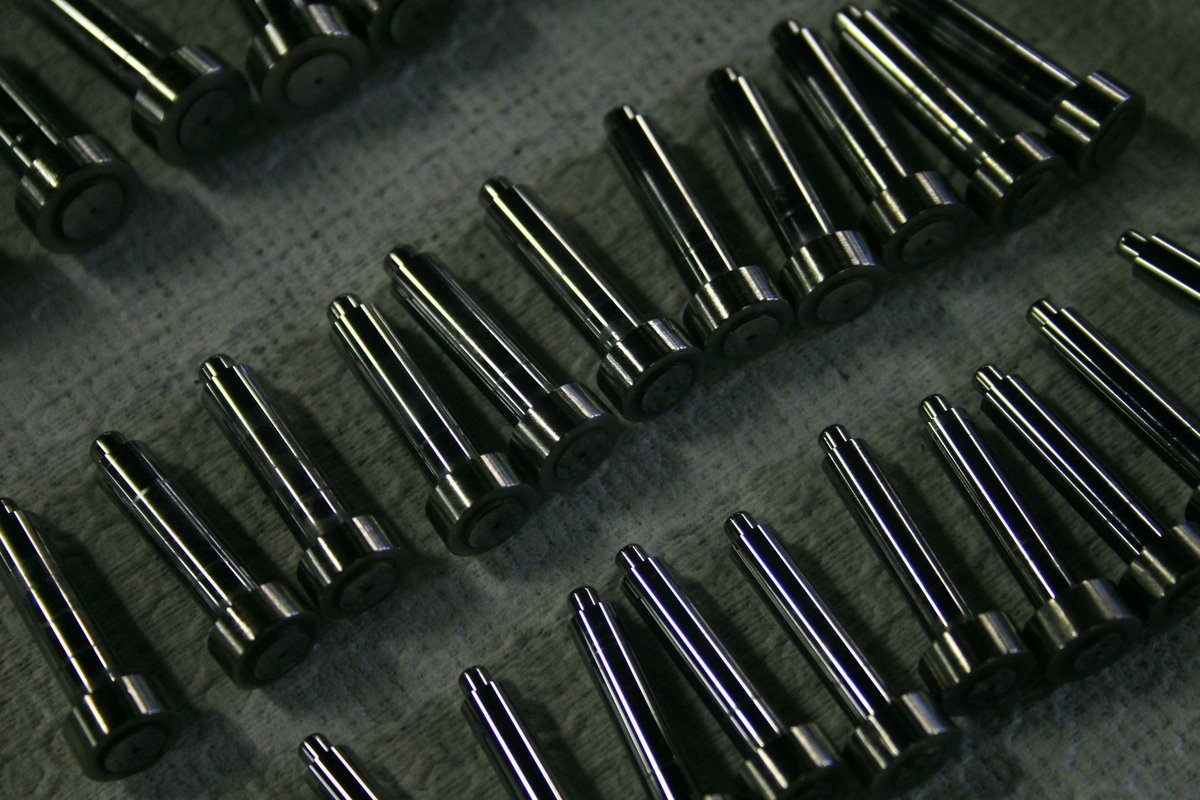
Pins fasten without threads, and they do three jobs bolts cannot do as well: locate parts repeatably, hinge parts freely, and lock other fasteners positively. Choosing among the types of pins comes down to which of those jobs the joint needs. Dowel pins are precision-ground to tight diameter tolerances and press-fit into reamed holes; a pair of them sets position to within hundredths of a millimeter, which is why fixtures, mold halves, and gearbox housings are doweled before they are bolted. Spring pins trade precision for forgiveness — the slotted (ISO 8752) or coiled versions compress as they are driven in and spring back against the hole wall, so they retain themselves under vibration without any secondary locking.
| Pin Type | How It Works | Typical Use |
|---|---|---|
| Dowel pin | Precision-ground solid cylinder, press-fit into reamed holes for repeatable location | Aligning plates, fixtures, gearboxes, mold halves |
| Spring pin (slotted) | Slotted tube that compresses on insertion and springs back to grip the hole | Retaining shafts and collars subject to vibration |
| Spring pin (coiled) | Rolled coil with 360-degree contact; more flexible than slotted pins | High-vibration and dynamic shear applications |
| Clevis pin | Headed pin with a cross hole, retained by a cotter pin or clip | Hinges, linkages, turnbuckles, tow points |
| Taper pin | 1:50 tapered shaft driven into a matching tapered hole for self-locking location | Permanent alignment on shafts, collars, couplings |
| Cotter pin | Split wire bent after insertion through a hole; a locking device, not a load carrier | Securing castle nuts and clevis pins |
| Grooved pin | Solid pin with swaged grooves that displace material for grip | Quick assembly where reaming is impractical |
For pivots and linkages, the clevis pin is the standard answer: a headed pin with a cross hole near the tip, retained by a cotter pin or clip, giving a joint that assembles and releases in seconds. Taper pins (ISO 2339, 1:50 taper) are the permanent locator — drive them into a matching tapered hole and they self-lock, ideal for pinning collars and couplings to shafts. And the humble cotter pin deserves respect: it carries no load itself, but it is what keeps castle nuts and clevis pins from walking off a machine at speed. Machining note: dowel holes should be reamed, not just drilled, and spring-pin holes can often be left as-drilled — one reason spring pins are cheaper to design in.
Washer Types: Plain, Spring Lock, Tooth Lock, and Belleville
Washers do four distinct jobs, and one washer rarely does more than two of them. Plain flat washers (DIN 125, or ASME B18.22.1 in imperial sizes) distribute bearing load under the head or nut and protect the surface from galling and embedment — essential on aluminum, oversized or slotted holes, and painted finishes. Form A is the standard outside diameter; larger-OD forms spread load further on soft material. They add no locking security at all.
Split spring lock washers (DIN 127) are the traditional anti-loosening answer, and the honest verdict from decades of vibration testing is unflattering: once a joint slips, the split ring flattens and behaves like a plain washer, and on hardened surfaces it cannot bite. They remain fine for light-duty, low-consequence joints, but several standards bodies have downgraded or withdrawn them. Tooth lock washers — internal teeth for small screws under heads, external teeth for maximum bite — serrate into the mating surfaces and do provide real resistance in light machinery and electrical bonding, at the cost of marring the finish.
For joints that must not loosen, skip the split ring and choose a proven method: Belleville disc spring washers, conical washers that flatten under load and maintain preload as the joint settles, paint creeps, or temperature cycles; prevailing-torque locknuts; anaerobic threadlocker; or positive mechanical locking with castle nuts and cotter pins. Pair the washer strategy with the right surface — our black oxide vs zinc plating comparison covers how finish choice affects friction, torque, and corrosion on the joint itself.
Materials and Coatings: Zinc-Plated Carbon Steel, Stainless A2 and A4, Alloy Steel
Zinc-plated carbon steel is the default fastener material for a reason: cheap, strong (classes 4.6 through 10.9), and adequately corrosion-protected for indoor service. Clear (blue) zinc is the standard; yellow chromate zinc survives longer. Hot-dip galvanized fasteners carry a much thicker zinc layer for structural and outdoor work, with oversized tapped nuts to accommodate the coating. Black oxide is a conversion coating that changes dimensions by less than a micron — it offers only mild corrosion resistance on its own, but it is the right choice for tooling, precision assemblies, and anywhere a tight thread fit cannot tolerate plating buildup.
Stainless fasteners trade strength for corrosion resistance. A2 (the 304 family) handles general outdoor, food, and washdown duty; A4 (the 316 family) adds molybdenum for chlorides and marine exposure. In class 70 form both reach 700 MPa tensile — respectable, but below a class 8.8 carbon-steel bolt. Two practical cautions apply. Stainless threads gall: the passive layers weld under friction and the nut can seize permanently, so use anti-seize, reduce installation speed, and avoid pairing identical grades. And do not assume stainless is always the upgrade — in a high-strength structural joint, a plated class 10.9 bolt usually beats an A2-70.
Alloy steel (the quenched-and-tempered family behind classes 10.9 and 12.9 and SAE Grade 8) is where maximum clamp load lives, typically sold plain or oiled and intended for protected service. One hard rule: electroplating high-strength fasteners invites hydrogen embrittlement. Hydrogen absorbed during plating can crack a class 12.9 or Grade 8 bolt hours after installation, so high-strength fasteners should be mechanically plated, zinc-flake coated, or properly baked after plating — a detail worth calling out on the purchase order, not just the drawing.
Fasteners on Machined Parts: Clearance Holes, Threads, and Joint Design
Every threaded joint on a machined part is two holes: a clearance hole on the clamped side and a tapped hole on the far side (or a nut behind it). The clearance hole follows one of three standard fits — close for locating joints, normal for general assembly, loose for adjustment and tolerance stack-up — and drilling to the wrong fit is one of the most common drawing errors we see. The standard drill sizes for every metric and imperial bolt are tabulated in our clearance hole chart; use it rather than calculating each hole from scratch.
The tapped side needs its own discipline. Thread engagement should run about one times the nominal diameter in steel and roughly twice the diameter in aluminum — beyond that, additional depth adds tap cost and breakage risk without adding strength. Tap drill sizes, pitches, and coarse-versus-fine choices are laid out in the thread sizes chart. Wherever possible, prefer through holes over blind holes: through holes tap deeper, evacuate chips, and gauge reliably, while blind holes demand bottoming taps and conservative depth callouts. The trade-offs are covered in blind vs through holes. And for socket head cap screws — the default fastener on precision machined assemblies — remember the counterbore: the head needs a spotface or counterbore diameter with enough wall around it, or the class 12.9 screw you specified will pull through a counterbore sized for a smaller head.
FAQ: Fasteners and Hardware
What is the difference between a bolt and a screw?
The classic distinction is how the fastener develops clamp load. A bolt is designed to pass through unthreaded clearance holes and be tightened against a nut — the clamp force comes from stretching the bolt between its head and the nut. A screw threads directly into one of the parts (a tapped hole) or cuts its own thread, so tightening happens between the head and the threaded part. In practice the same hex-head product can serve as either, which is why standards define them by intended use rather than shape. Socket head cap screws, for example, almost always thread into a tapped hole. When you specify hardware on an assembly drawing, the distinction matters for the machining: bolts need clearance holes on both parts, screws need one clearance hole and one tapped hole.
What do bolt grades 8.8, 10.9, and 12.9 actually mean?
They are ISO 898-1 property classes, and the two numbers are a coded strength spec. The first digit is the minimum tensile strength in MPa divided by 100; the second digit is the yield-to-tensile ratio times 10. So class 8.8 means 800 MPa minimum tensile and 0.8 × 800 = 640 MPa minimum yield. Class 10.9 is 1,000 MPa tensile and 900 MPa yield; class 12.9 is 1,200 MPa tensile and 1,080 MPa yield. Higher classes are quenched-and-tempered alloy steel and allow more clamp load from the same diameter — or the same clamp load from a smaller bolt. The imperial equivalents under SAE J429 are Grade 5 (roughly class 8.8) and Grade 8 (roughly class 10.9), identified by radial lines on the head.
What are the main types of pins used in mechanical assemblies?
Five pin families cover most designs. Dowel pins are precision-ground solid cylinders press-fit into reamed holes to locate parts repeatably — fixtures, plates, and gearbox housings. Spring pins (slotted or coiled) are hollow, compress on insertion, and spring back to grip the hole, which makes them self-retaining under vibration. Clevis pins are headed pins with a cross hole, used with a cotter pin or clip to make quick-release hinges and linkages. Taper pins are driven into a matching 1:50 tapered hole and self-lock, giving permanent alignment on shafts and collars. Cotter pins themselves are locking devices, not load carriers — they keep castle nuts and clevis pins from backing off. Choose by whether the pin must locate precisely, survive vibration, release quickly, or lock permanently.
Which washer type actually prevents a bolt from loosening?
Fewer than most people assume. A plain flat washer (DIN 125) only distributes load and protects the surface — it adds no locking security. Split spring lock washers (DIN 127) are the traditional answer, but independent vibration testing (Junker-type tests) has repeatedly shown they add little resistance once the joint slips, especially on hardened surfaces; some standards bodies have withdrawn them. Tooth lock washers (internal or external serrations) bite into the surfaces and do better in light-duty and electrical grounding applications, at the cost of marring the finish. For genuinely critical joints, the proven options are Belleville disc spring washers that maintain preload as the joint settles, prevailing-torque locknuts (nylon insert or all-metal), chemical threadlocker, or positive locking with castle nuts and cotter pins.
Should I use zinc-plated, black oxide, or stainless fasteners?
Match the fastener to the environment first, then to strength. Zinc plating on carbon steel is the general-purpose default — cheap, bright, and adequate for indoor service; yellow chromate versions last somewhat longer. Black oxide is a conversion coating with minimal corrosion protection and essentially no dimensional change, so it suits precision assemblies, tooling, and interiors where appearance matters more than weathering. For outdoor, washdown, food, or marine exposure, go stainless: A2 (304) for general corrosion resistance, A4 (316) where chlorides are present; class 70 versions reach 700 MPa tensile. Two cautions: electroplated fasteners above roughly class 10.9 strength carry a hydrogen-embrittlement risk unless properly baked, and stainless threads gall easily — use anti-seize or lubricant and avoid matching the same stainless grade on bolt and nut.
How do I size a clearance hole for a bolt in a machined part?
Standards define three fits. A close fit clears the bolt by about 0.1–0.2 mm (use it when the hole pattern must also locate the parts), a normal or medium fit clears by roughly 0.2–0.4 mm for general assembly, and a loose fit clears by 0.5 mm or more to absorb stack-up and allow adjustment. For an M10 bolt that works out to roughly 10.5, 11, and 12 mm respectively under the ISO 273 series. Choose the fit from function: close fit plus dowel pins when position matters, normal fit for typical bolted covers and brackets, loose fit for slotted adjustment or large weldments. Our clearance hole chart lists the standard drill sizes for every metric and imperial bolt, and the tapped-hole side of the joint is covered in the thread sizes chart.
Related Resources

CNC Machining Surface Finish: The Ra Chart, Explained
The CNC machining surface finish chart: Ra values in μm and μin, N1–N12 grades, what each process achieves, what…

Passivation of Stainless Steel: Process, Specs, and When Parts Need It
Passivation of stainless steel explained for machined parts: the chemistry, ASTM A967 and AMS 2700 methods, nitric…

GD&T Basics for CNC Machined Parts: The Symbols That Matter
GD&T basics for machined parts: the 14 symbols explained, feature control frames, datums, MMC bonus tolerance, true…

How to Outsource CNC Machining to China, Step by Step
How to outsource CNC machining to China, step by step: vet suppliers, compare landed cost, control quality remotely,…
Building Assemblies, Not Just Parts?
IsoCNC machines the housings, plates, pins, and shafts your fasteners hold together — with reamed dowel holes, correct clearance and tap drill sizes, and inspection reports on every lot. Send the drawing and an engineer will flag any hole, thread, or material callout that will cost you time in assembly, typically within 1–2 business days.